- +91 63054 35011
- info@medtx.in/operations@medtx.in
- HYD, TS

ICD Surgery
Implantable Cardioverter Defibrillator (ICD) surgery involves placing a small device in the chest to monitor and regulate abnormal heart rhythms. The ICD delivers electrical shocks to restore a normal heartbeat in cases of life-threatening arrhythmias or cardiac arrest. The procedure is minimally invasive, performed under local anesthesia with sedation, and usually completed within a few hours. Recovery is quick, with most patients resuming normal activities in a few days. The ICD provides long-term protection against sudden cardiac events.

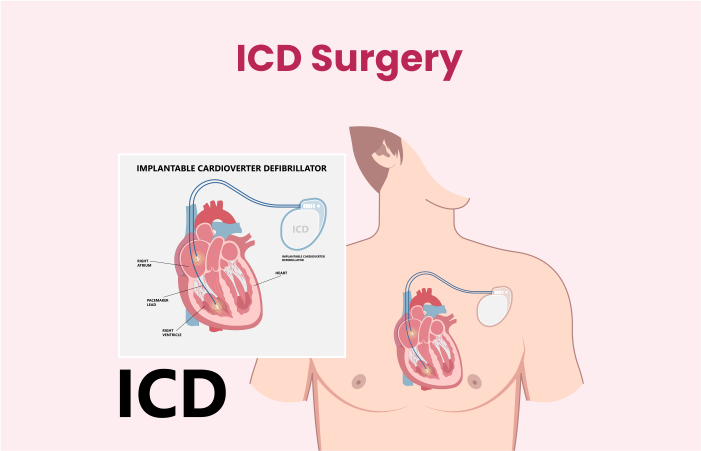
ICD Implantation
We at MedTX Hospitals provide state-of-the-art care for patients with cardiac issues, specializing in the surgical implantation and placement of ICDs. The importance of ICDs, their surgical techniques, and the advantages they offer for heart health will all be covered in this article.
Cardiac Defibrillator Placement
- The Surgical Process: We specialize in implanting ICDs with minimally invasive operations.
- Anesthesia and Incision: To gain access to the chest region, a tiny incision is made after the patient is put under general anesthesia.
- Device Location: The ICD is placed under the skin, usually immediately below the rib cage or close to the collarbone.
- Lead Insertion: To connect the ICD to the heart, small cables called leads are carefully inserted into veins.
- Closure and Testing: The wound is sealed with surgical staples or sutures once the device has been tested to guarantee correct operation.
Benefits of Implantable Cardioverter Defibrillators (ICDs)
- Life-Saving Technology: ICDs are made to identify and manage hazardous cardiac rhythms like ventricular tachycardia or ventricular fibrillation.
- Immediate Intervention: To restore a normal heart rhythm in the event of a potentially fatal arrhythmia, the ICD shocks the patient with electricity.
- Prevention of Sudden Cardiac Arrest: ICDs can successfully prevent sudden cardiac arrest and provide patients and their loved ones peace of mind by continuously monitoring heart function.
- Customized Programming: Every ICD is made to fit the demands of each patient, guaranteeing that the right treatment is administered in accordance with the particular electrical patterns of each heart.
Preparing for Implantable Cardioverter Defibrillator (ICD) Surgery
- Medical Evaluation: To ascertain whether an ICD is the right course of treatment for you, our skilled staff performs a comprehensive evaluation.
- Preoperative Instructions: Before the procedure, you will be given comprehensive instructions about fasting, prescription drugs, and other testing that may be required.
- Organizing Support: Having someone go with you on the day of the procedure and help with your postoperative care is crucial.
More about Implantable Cardioverter Defibrillators (ICDs)
- Battery Life and Replacement: The batteries in ICDs are long-lasting and usually last for a number of years. A straightforward outpatient surgery is carried out to replace the battery as it approaches depletion.
- Frequent Follow-up and Monitoring: To make sure the ICD is operating at its best and to make any necessary corrections, routine follow-up and monitoring are crucial.
- Lifestyle Considerations: After ICD implantation, most activities can be resumed, although some safety measures, such avoiding strong magnetic fields and going through extra security checks at airports, might be suggested.
MedTX Hospitals places a high priority on our patients’ health and wellbeing, providing cutting-edge treatments including implantable cardioverter defibrillators (ICDs) to support heart health. We are dedicated to giving you the best treatment possible during your journey with our talented team of medical specialists. To arrange a consultation or find out more about ICDs and their potential to save lives by preventing sudden cardiac arrest, get in touch with us right now.
Frequently Asked Questions (FAQs)
Implanted beneath the skin, usually close to the collarbone, is a tiny electronic device called an implantable cardioverter defibrillator (ICD). When aberrant or potentially fatal heart rhythms are discovered, it continually checks the heart's rhythm and provides electrical shocks or pacing.
In order to treat or prevent potentially fatal arrhythmias (abnormal heart rhythms) such ventricular tachycardia or ventricular fibrillation, ICD implantation is done. It is frequently advised for people who have had sudden cardiac arrest or arrhythmias or who are at high risk of developing them.
Conscious sedation and local anesthesia are typically used during the ICD implantation operation. Leads, or thin wires, are inserted into the heart chambers through a tiny incision performed close to the collarbone and into the blood veins. The ICD is positioned beneath the skin once these leads are connected to it. Usually, the process takes one to two hours to finish.
The placement of an ICD is regarded as a minor surgical procedure. Although a little incision must be made and leads must be inserted into the heart, this procedure is less invasive than open heart surgery. Most patients are able to return home the same day or the following day following the operation.
You can see a tiny lump or bulge beneath the skin where the ICD is positioned after it has been implanted. Nonetheless, the ICD is usually well tolerated and shouldn't be very uncomfortable.